


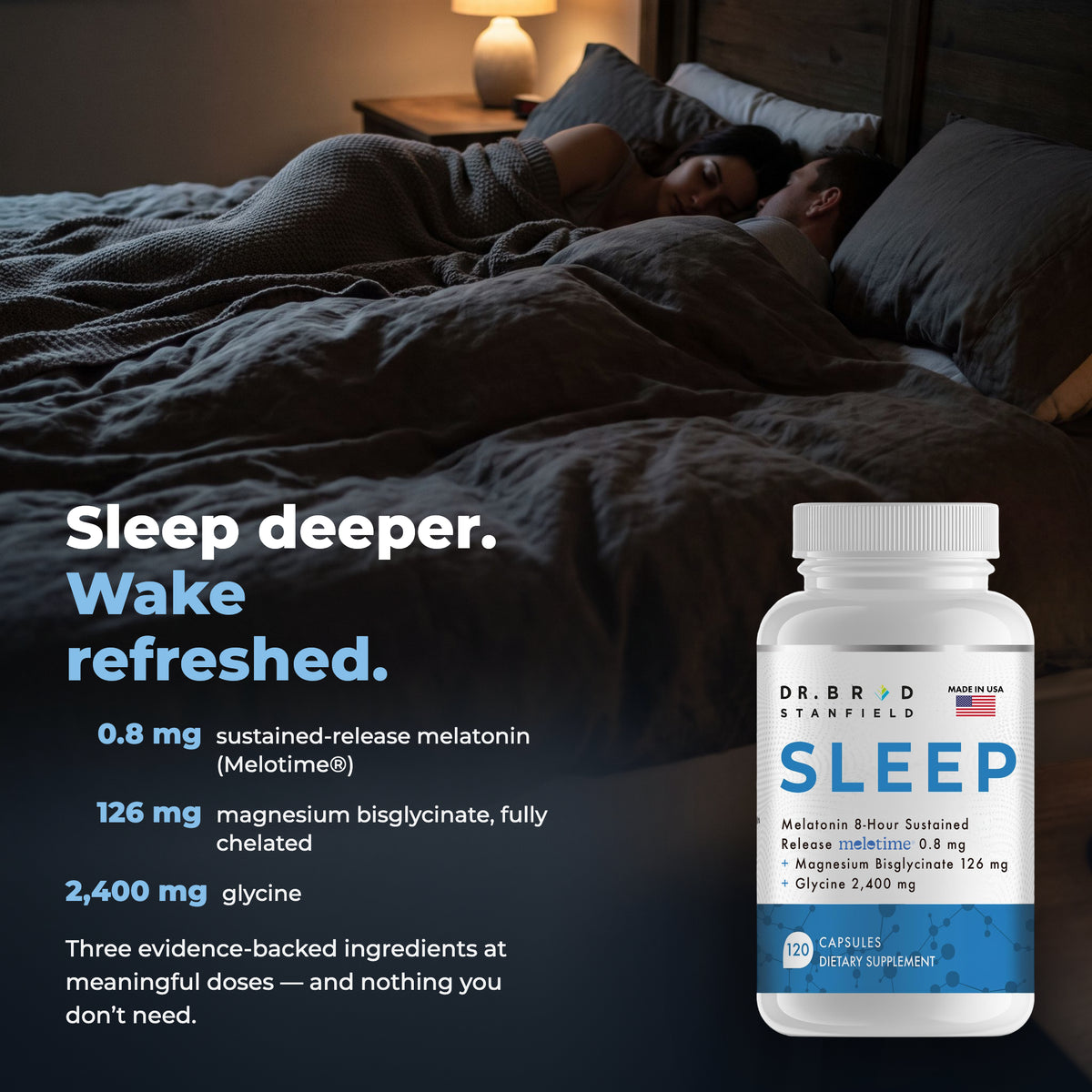
Melatonin 0.8 mg (8-hour sustained release)
+ Magnesium Bisglycinate (elemental) 126 mg
+ Glycine 2,400 mg
4 capsules per serving, best taken 3 hours
before you want to fall asleep.
Third-party tested by Labdoor, with independent analysis by Eurofins. See the Labdoor report.
Impossible de charger la disponibilité du service de retrait


Fall Asleep Faster, Sleep Deeper, Wake Refreshed
Sleep is a blend of sustained-release melatonin, fully chelated magnesium bisglycinate, and glycine to help you fall asleep faster, sleep through the night, and wake up refreshed. Each ingredient does a different job, and each is backed by human trials. Here’s how they work:
Version 2 (2026): melatonin moved from 0.3 mg immediate-release to 0.8 mg sustained-release (Melotime®), the magnesium is now fully chelated bisglycinate, and glycine is 2,400 mg. The full list of changes is in the FAQ below.

Low-Dose, Sustained-Release Melatonin (0.8 mg)
A Gentle Signal, Released Slowly
Melatonin is the body’s natural “sleep hormone.” Meta-analyses of clinical trials show that melatonin can help people fall asleep faster [1] and improve overall sleep quality [2].
Most supplements get the dose wrong. You will often see 3 mg or even 5 mg capsules on the shelf. These flood your receptors with far more hormone than your body ever makes in a night. Sleep bases the dose on human physiology instead.
The Science of the Low Dose
Each night, your body produces somewhere between 10 and 80 mcg of melatonin [15], and direct measurements put most adults at 20–35 mcg [3, 4]. That small amount is enough to start your natural sleep process. But only about 15% of oral melatonin reaches your bloodstream [5]. Your liver breaks down the rest.
Sleep contains 0.8 mg (800 mcg) of melatonin. After absorption, roughly 120 mcg reaches your bloodstream, spread across the evening and the night rather than arriving all at once. That is a few times what your body makes on its own, and a small fraction of what a 3 mg capsule delivers.

Why sustained release?
Ordinary melatonin peaks within about an hour and its blood level falls within a few hours. That helps you fall asleep, and it leaves little melatonin for later in the night. Sleep uses Melotime®, a sustained-release form. In a head-to-head pharmacokinetic study, the sustained-release capsule produced half the peak level of an immediate-release capsule and its half-life was about 5 hours, against 1 hour for immediate-release; levels after hour 4 were higher with sustained release, though in a study of 16 people that difference was not statistically significant [14]. The dose is released gradually: a lower peak, and a lower level kept going later into the night.
Why 3 hours before bed?
Melatonin works best when it is taken before your own evening melatonin starts to rise [7]. Taking Sleep about 3 hours before you want to fall asleep moves the sleep-wake cycle earlier, and the sustained release then keeps a lower level going later into the night.
Why not take more?
In an MIT study, researchers compared 0.1 mg, 0.3 mg, and 3.0 mg in adults over 50 with sleep difficulties [6]. The 0.3 mg dose restored sleep efficiency and raised melatonin to normal nighttime levels. The 3.0 mg dose also improved sleep, but it lowered body temperature and kept melatonin elevated well into the daylight hours.
A separate study in healthy young adults found that 0.3 mg of melatonin shortened the time to fall asleep without any "hangover effects" the next morning [7]. Higher doses have been linked with morning grogginess and receptor desensitization, meaning you may need more and more to get the same effect [8].
Sleep sits in between: a low dose, released slowly, and still about a quarter of the smallest common 3 mg capsule.
Magnesium Bisglycinate (126 mg elemental, fully chelated)
Highly Absorbable Magnesium for Sleep
Magnesium is an essential mineral that supports relaxation and healthy sleep. Sleep includes 126 mg of elemental magnesium as fully chelated bisglycinate: every magnesium is bound to two glycine molecules. That makes it easy to absorb and easy on the stomach (it avoids the laxative effect magnesium oxide and citrate can cause), and the glycine it carries counts toward the glycine dose below.
In an 8-week placebo-controlled trial in older adults with poor sleep, those who took 500 mg of magnesium nightly had significantly longer sleep time, higher sleep efficiency, and shorter time to fall asleep compared to those taking a placebo [9]. A 2021 systematic review and meta-analysis also found that magnesium supplementation reduced the time it takes to fall asleep by about 17 minutes in older adults with poor sleep [10].
Glycine (2,400 mg)
The Sleep-Supporting Amino Acid
Glycine is a naturally occurring amino acid that has been studied in several human trials for its impact on sleep. It has calming neuromodulator effects and helps lower core body temperature at bedtime, which together promote better sleep architecture.
Three randomized controlled trials have demonstrated that taking 3 grams of glycine before bed can improve sleep quality, reduce time to fall asleep, and reduce fatigue the next day, all without sedative side effects [11][12][13]. Sleep includes 2,400 mg of glycine per serving, counting the glycine carried by the magnesium chelate, to help you fall asleep more easily, sleep deeper, and wake up with more energy and a clearer head.
Clean, Natural, and Blue
- No artificial colors or dyes – We use natural blue spirulina for a calming bluish hue, reminiscent of the night sky.
- No titanium dioxide – A synthetic colorant often used in supplements, but not here.
- Plant-based – Made from plant-based materials with no genetically modified ingredients.
- No unnecessary fillers – Every ingredient has a purpose. No fluff.
- Non-habit-forming – Gentle enough for nightly use without causing dependency.
- Third-party tested – Certified by Labdoor, with independent analysis by Eurofins. Label accuracy, purity, and microbiology all passed. See the Labdoor report.
Assurance qualité
Nous nous sommes associés à un fabricant américain de compléments alimentaires, « Makers Nutrition », pour produire MicroVitamin. Leurs installations sont auditées GMP et enregistrées auprès de la FDA, vous pouvez donc être assuré que MicroVitamin est méticuleusement produit et minutieusement testé pour la qualité.
Voici les labels d'approbation pour lesquels Makers Nutrition est qualifié :


Why Most Sleep Supplements Get It Wrong
More isn't better when it comes to sleep ingredients. Most supplements use several times too much melatonin, release it all at once, and pick the cheapest form of magnesium. Sleep is formulated around what the evidence supports.
| Most Sleep Supplements | Sleep | |
|---|---|---|
| Melatonin dose | 3–10 mg, all at once | 0.8 mg, sustained release |
| Magnesium form | Oxide | Bisglycinate, fully chelated |
| Glycine | Not included | 2,400 mg |
| Unnecessary additives | Common | None |
Tap any question below
Foire aux questions
Le sommeil est-il végétalien/végétarien ?
Oui, les gélules Sleep by Dr Brad sont véganes. L'enveloppe de la gélule est d'origine végétale (sans gélatine), et aucun des ingrédients n'est dérivé d'animaux.
Pourquoi utiliser ce complément 2 heures avant de vouloir s'endormir ?
La mélatonine est un agent chronobiotique, ce qui signifie qu'elle aide à réguler le cycle veille-sommeil du corps.
Elle fonctionne mieux comme supplément lorsqu'elle est prise avant que la mélatonine naturelle du corps ne commence à augmenter le soir (généralement environ 2 heures avant de vouloir s'endormir).
Cela aide à avancer le cycle veille-sommeil, vous aidant ainsi à vous endormir plus rapidement.
Qu'est-ce que la spiruline ?
La spiruline est une algue bleu-vert naturelle (cyanobactérie). Elle contient également un pigment bleu vif appelé phycocyanine, dont l'extrait est utilisé comme colorant naturel dans les aliments et les compléments. Dans ce produit, la couleur bleue des gélules provient de la spiruline plutôt que de colorants artificiels.
Pourquoi y a-t-il un avertissement de la Proposition 65 ?
Étant donné qu'il s'agit du premier lot de fabrication, nous avons été tenus d'afficher l'avertissement de la Proposition 65 de la Californie.
Maintenant que nous avons terminé notre premier lot et démontré avec notre certificat d'analyse qu'il s'agit d'un produit de haute qualité, pour les futurs lots, nous pourrons supprimer l'avertissement Prop65.
Pourquoi la dose de mélatonine n'est-elle que de 300 µg (beaucoup plus faible que de nombreux autres somnifères) ?
La plupart des suppléments de mélatonine en vente libre contiennent 3 000 à 10 000 mcg (3 à 10 mg), ce qui est bien supérieur à la production naturelle nocturne de mélatonine par l'organisme (environ 20 à 35 mcg) [3, 4].
Des doses élevées peuvent rester dans la circulation sanguine jusqu'au lendemain matin, provoquant potentiellement des étourdissements ou une désensibilisation hormonale au fil du temps [6]. En revanche, 300 mcg (0,3 mg) est une dose physiologique dont il a été démontré dans des essais cliniques qu'elle améliorait l'efficacité du sommeil tout aussi efficacement que des doses plus élevées, mais sans les effets secondaires [6].
Cette approche soutient le rythme naturel de votre corps sans le surcharger.
What changed in Sleep version 2?
Version 2 (batch dated February 2026, on sale from August 2026) makes three changes to the formula. Price, serving size (4 capsules) and bottle size (30 servings) are unchanged.
1. Melatonin: 0.3 mg immediate-release became 0.8 mg sustained-release (Melotime®). The version 1 dose helped people fall asleep, but immediate-release melatonin peaks within about an hour and its blood level falls within a few hours. Version 2 releases the melatonin gradually, so a lower level is kept going later into the night. The dose is higher because only about 15% of oral melatonin is absorbed [5] and that absorbed amount is now spread across roughly 8 hours instead of arriving at once. After absorption it works out to around 120 mcg, still far below a standard 3 mg capsule.
2. Magnesium is now fully chelated bisglycinate. The magnesium glycinate in version 1 was not fully chelated. In version 2 every magnesium is bound to two glycine molecules, which is the form the absorption and tolerability evidence is based on. Elemental magnesium stays at 126 mg.
3. Glycine: 2,500 mg became 2,400 mg. The label now counts the glycine carried by the magnesium chelate, and 2,400 mg is the most that fits in a 4-capsule serving. The glycine trials used 3 g [11, 12, 13], so version 2 stays close to that dose without moving to 5 capsules.
Because the melatonin now releases slowly, the suggested timing moved from 2 hours to 3 hours before you want to fall asleep. Version 2 is also third-party tested: certified by Labdoor with independent analysis by Eurofins. See the Labdoor report.
Peut-on prendre ce supplément tous les soirs à long terme sans danger ?
Oui, ce complément est conçu pour un usage régulier et contient des ingrédients considérés comme sûrs pour une utilisation à long terme chez les adultes en bonne santé.
La mélatonine a été étudiée dans des essais cliniques sans preuve de sevrage ou de tolérance à faibles doses [1, 2].
Le magnésium et la glycine sont des nutriments essentiels ou des acides aminés avec d'excellents profils de sécurité lorsqu'ils sont utilisés dans les fourchettes de supplémentation typiques [9, 10] et [11, 12, 13].
Comme toujours, consultez votre professionnel de la santé si vous avez des problèmes de santé sous-jacents ou si vous prenez des médicaments qui affectent le sommeil ou la neurotransmission.
Vais-je me sentir groggy le lendemain matin après l'avoir pris ?
Peu probable. Contrairement aux suppléments de mélatonine à forte dose qui peuvent laisser une somnolence résiduelle, la dose de 300 mcg de cette formule est suffisamment faible pour disparaître au matin, ce qui vous aide à éviter l'effet de « gueule de bois à la mélatonine » [6, 7].
En fait, la recherche montre qu'une faible dose de mélatonine combinée à de la glycine peut vous aider à vous sentir plus frais et alerte le lendemain, et non groggy [13].
Ce supplément est formulé pour favoriser un sommeil réparateur tout en permettant un matin clair et énergique.
I am looking forward to the slow release melatonin version as i still have issues with 3am wakeups

I have a tendency to wake up at 3am and Sleep by Dr Brad, particularly with the version 2 upgrade, may help me with this issue

excellent
excellent
I’m a flight attendant, and after working transoceanic trips, this has become an essential part of my routine to get back into my normal rhythm. It never leaves me feeling groggy- just purely relaxed. It gently nudges you into a restful sleep. Highly recommend!
Sleep is well researched and Dr. Brad keeps updating his formulae for both supplements (Sleep & Microvitamin) as new research emerges.
The price is fair and it personally improved my sleep significantly.
Really good! It has improved my sleep.
Brilliant combination of the three ingredients I want to help my sleep cycle. While the 4 pill serving size could be a hurdle for folks who struggle with larger capsules, no problem for me. Am appreciative of this offering.
I have been using this product for a couple years. It does make a difference in the duration and quality of sleep. I find myself not waking up several times during the night as I did before taking this supplement.
Highly recommended
This supplement shows that high doses of melatonin, which can be problematic in the long term, are not necessary for a restful sleep. Combined with magnesium and glycine, the formula is really effective.
It’s a pleasant ritueel taking the sleep pills (also take glynac supplement). Fall asleep after reading a few lines. Wake up after about 5 hours.
Was previously taking a combination of pills for sleep support. This formula puts it all in one and also helps eliminate morning grogginess.
It doesn't appear to have had any effect on my sleep.
It is good to have someone I trust formulating the supplements I take and updating them as science dictates. Thank you, Dr. Brad
It’s very good but what about a little tryptophan addition?
I have been taking the SLEEP capsule supplement for about a month and I have noticed my sleep habits have definitely improved.
I am going to reorder and I will update you.
Definitely helping although still often waking about 4-5 am but find I usually drift back to sleep till about 7. No hangover.
I haven't slept well for years and I still have to wake up to urinate several times a night and because of that I have to drink about 320 ml of water sometime after 2am to fight of cramps which I suffer from. Before taking Sleep and trying to sleep through my discomforts I would have agonizing cramps that left painful effects all the following day. Whether it's because I recognize the onset of symptoms of cramp or because of the possible placebo of Sleep I have a less disruptive sleep, which is a much as I could hope for.
Sleep by Brad is working great! I've yet to wake up after going to sleep. Not only that but it's a good dose of Magnesium so I haven't had cramps lately either. Keep up the good work, can't wait for your next formula. How about a supplement that turns gray hair back to normal?
Genuinely helped give me better sleep and allow me to fall asleep faster. Full time firefighter so I often have irregular sleep and wake up randomly even at home, I can even take it at the firehouse and I have no issues waking up for the tones when they alarm at like 2am in the morning.
Love falling asleep with the SLEEP compound. My only issue is I wake up 4-5 hours after a great deep sleep.
Excellent help with going to sleep
Since I've been taking "Sleep by Dr Brad" I fall asleep faster, I don't get leg cramps, and I sleep through the night more often.
I've found it much easier to fall asleep and stay asleep. I wake up with energy and have found myself far less sleepy thoughout the day.
Since starting taking this I've been sleeping through the night. Previously, I would wake up three or four times. And no tossing and turning through the evening. Funny thing is... I've been taking the ingredients separately, although not in the same formulation.
Simple, pure products we need and it works.
I'm very satisfied taking MicroVitamin+ Powder, Sleep, a vegan protein supplement and a little extra Collagen Peptide.
I take Sleep capsules about an hour before bed. It helps with leg cramps and helps me relax to go to sleep.
I can’t believe how good I feel since starting the sleep supplements at night. I am actually sleeping 7 hours straight (would love to get that up to 8)… from years of broken sleep, on call, raging insomnia. Omg. I am a new person!
Deeper, Longer Sleep. I used to wake around 3PM every night, after which I lay there half awake, lucky if I could snatch another hour or so of rest. Deep Sleep has made it possible for me to sleep for cc7 hours, and if I do wake up, I now go back to sleep within a goer time. A great product.
Dr. Stanfield’s multi is fantastic because he keeps it up to date by tweaking the ingredients following the latest research.
Un mot du Dr Brad Stanfield, médecin de premier recours
Mon objectif principal est de soutenir le bien-être de mon public. Je ne saurais trop insister sur le fait qu'une alimentation équilibrée passe avant tout, et je vous conseille vivement de consulter votre professionnel de la santé avant de commencer tout supplément.
Des questions/commentaires ?
Si vous souhaitez obtenir de plus amples informations sur Sleep by Dr Brad, veuillez nous contacter en utilisant le formulaire ci-dessous
Formulaire de contact
References
- Ferracioli-Oda, E., Qawasmi, A., & Bloch, M. H. (2013). Meta-analysis: Melatonin for the treatment of primary sleep disorders. PLoS One, 8(5), e63773. https://doi.org/10.1371/journal.pone.0063773
- Gholami, F., et al. (2022). Effect of melatonin supplementation on sleep quality: A systematic review and meta-analysis. Journal of Neurology, 269(1), 205–216. https://doi.org/10.1007/s00415-020-10381-w
- Fourtillan, J. B., et al. (2001). Melatonin secretion occurs at a constant rate in both young and older men and women. American Journal of Physiology-Endocrinology and Metabolism, 280(1), E11–E22. https://doi.org/10.1152/ajpendo.2001.280.1.E11
- Mahle, C. D., et al. (2004). Melatonin secretion in older adults with insomnia. The American Journal of Medicine, 116(2), 91–95. https://doi.org/10.1016/j.amjmed.2003.08.026
- DeMuro, R. L., et al. (2000). The absolute bioavailability of oral melatonin. Journal of Clinical Pharmacology, 40(7), 781–784. https://doi.org/10.1177/009127000004000712
- Zhdanova, I. V., et al. (2001). Melatonin treatment for age-related insomnia. Journal of Clinical Endocrinology & Metabolism, 86(10), 4727–4730. https://doi.org/10.1210/jcem.86.10.7901
- Zhdanova, I. V., et al. (1996). Effects of low oral doses of melatonin, given 2-4 hours before habitual bedtime, on sleep in normal young humans. Sleep, 19(5), 423-431. https://doi.org/10.1093/sleep/19.5.423
- Wurtman, R. J. (2005). Low melatonin doses work best for insomnia. MIT News. https://news.mit.edu/2005/melatonin
- Abbasi, B., et al. (2012). The effect of magnesium supplementation on primary insomnia in elderly: A double-blind placebo-controlled clinical trial. Journal of Research in Medical Sciences, 17(12), 1161–1169. https://www.ncbi.nlm.nih.gov/pmc/articles/PMC3703169/
- Mah, J., & Pitre, T. (2021). Oral magnesium supplementation for insomnia in older adults: A systematic review & meta-analysis. BMC Complement Med Ther, 21, 125. https://doi.org/10.1186/s12906-021-03297-z
- Inagawa, K., et al. (2006). Subjective effects of glycine ingestion before bedtime on sleep quality. Sleep and Biological Rhythms, 4(1), 75–77. https://doi.org/10.1111/j.1479-8425.2006.00193.x
- Bannai, M., et al. (2012). The effects of glycine on subjective daytime performance in partially sleep-restricted healthy volunteers. Frontiers in Neurology, 3, 61. https://doi.org/10.3389/fneur.2012.00061
- Yamadera, W., et al. (2007). Glycine ingestion improves subjective sleep quality in human volunteers, correlating with polysomnographic changes. Sleep and Biological Rhythms, 5(2), 126–131. https://doi.org/10.1111/j.1479-8425.2007.00262.x
- Thanawala, S., Abiraamasundari, R., & Shah, R. (2024). Comparative pharmacokinetics of sustained-release versus immediate-release melatonin capsules in fasting healthy adults: A randomized, open-label, cross-over study. Pharmaceutics, 16(10), 1248. https://doi.org/10.3390/pharmaceutics16101248
- Kor, Y., et al. (2014). Preliminary study: Evaluation of melatonin secretion in children and adolescents with type 1 diabetes mellitus. Indian Journal of Endocrinology and Metabolism, 18(4), 565–568. https://doi.org/10.4103/2230-8210.137521
