Skip to product information
1 of 7

Potassium Fiber Drink

Potassium Fiber Drink

23.400 HUF

390 HUF per drink · 60 servings in the pouch

Taxes included. Shipping calculated at checkout.

A lemon and lime drink with 10 g of fiber and 500 mg of potassium in every scoop, two of the four nutrients the 2020-2025 Dietary Guidelines for Americans name as underconsumed and of public health concern. The fiber is acacia gum, which stirs into cold water without setting into a gel, so the glass stays thin.

Quantity | 1 month's supply per bottle (max 12 per order)

Pre-sale · ships from 1 December 2026

3 pouches ordered so far

1,497 of 1,500 left in the first run

You are charged today, when you check out. Cancel before your order is dispatched for a full refund.

View full details
  • 10 gfiber per scoop, from acacia gum. 36% of the Daily Value.
  • 500 mgpotassium per scoop, as potassium citrate. 11% of the Daily Value.
  • 60servings in a pouch, about two months at one scoop a day
  • 390 HUF per drink23.400 HUF for the pouch

What's in a scoop

The targets and intake figures below are not ours. They come from the bodies that set nutrition targets and the national surveys that measure what people actually eat.

Fiber

The recommendation runs from 21 to 38 grams a day, by age and sex. US adults average about 16.

The National Academies set the Adequate Intake, their daily target, at 38 grams of fiber for men and 25 for women aged 19 to 50, and 30 and 21 from 51. One scoop adds 10 grams, 36% of the Daily Value on the label, so the drink is high in fiber.

Fiber intake against the targets for women and men US adults eat about 16 grams of fiber a day. One scoop adds 10 grams, for 26 grams in total. The dashed lines mark the Adequate Intake for ages 19 to 50: 25 grams a day for women and 38 for men. 26 grams meets the women's targets and leaves men 12 grams short, or 4 grams short from age 51, when the targets are 21 grams for women and 30 for men. Women 25 g Men 38 g US adults eat 16 g Plus one scoop +10 g 26 g 0 10 20 30 40 Grams a day, ages 19 to 50. 26 g meets women's targets and leaves men 12 g short, or 4 g short from age 51.

US intake is national survey data (NHANES 2001 to 2010) pooled by McGill 2015. Kellogg, a cereal company, funded that paper; two of its authors were paid Kellogg consultants and the third had worked for Kellogg.

Potassium

3,400 mg a day for men, 2,600 for women

The National Academies set those figures in 2019 as the adult Adequate Intake. One scoop carries 500 mg, roughly what a large banana gives you. That is 11% of the 4,700 mg Daily Value on the label, which makes the drink a good source of potassium. Against the Adequate Intake, one scoop is about 19% for women and 15% for men.

A 500 mg scoop against the adult potassium targets and the label's Daily Value One scoop carries 500 milligrams of potassium. That is about 19 percent of the 2,600 milligram Adequate Intake for women, about 15 percent of the 3,400 milligram Adequate Intake for men, and 11 percent of the 4,700 milligram Daily Value used on US labels. All three bars are drawn on the same milligram scale. Women's target, 2,600 mg about 19% Men's target, 3,400 mg about 15% Label Daily Value, 4,700 mg 11% 0 1,000 2,000 3,000 4,000 Milligrams a day. One scoop, 500 mg

Targets: the adult Adequate Intake, National Academies 2019. Daily Value: the 4,700 mg figure US labels use.

The fiber

A fiber drink you don't have to brace for

The best-known fiber supplement, psyllium husk, turns water into a gel. The gel is the point of it, and it's also why a psyllium drink gives you about thirty seconds before the glass starts to set.

Acacia gum behaves differently. It's the dried sap of the acacia tree, its known uses go back thousands of years, and it dissolves into cold water leaving it close to as thin as it started. What you get is a clear amber-brown drink, roughly the color of weak tea, sharp with lemon and lime.

Psyllium has far more trial evidence behind it than acacia gum, and a tub of it costs less than this drink. Other fibers dissolve clear too.

What three soluble fibers do to a glass of cold water, from thinnest to thickest Three glasses, from thinnest to thickest. Acacia gum, the fiber in this drink, stays thin and clear. Oat beta-glucan works by forming a gel, so the drink turns thick. Psyllium husk sets into a gel firm enough for a spoon to stand up in it. The drawing shows the order, not measured values. Acacia gum, in this drink Stays thin and clear. Oat beta-glucan Works by forming a gel, so the drink turns thick. Psyllium husk Sets into a gel. A spoon stands up in it.
Three soluble fibers stirred into cold water, thinnest to thickest. Psyllium and oat beta-glucan work by forming a gel; acacia gum is one of the soluble fibers that thickens water least.
A glass of Potassium Fiber stirred into water on a kitchen counter
Mixed and ready to drink. It stays thin rather than setting.

Directions

How to take it

Adding a lot of fiber at once can bring gas and bloating.

Start low: half a scoop a day for the first week or two, then one scoop a day Weeks 1 and 2: half a scoop a day. Week 3 onward: one scoop a day. Two scoops a day at most. Half a scoop a day One scoop a day Weeks 1 and 2 Week 3 onward
  1. 1

    Half a scoop

    Once a day for the first week or two, while your gut adjusts. That is the standard advice and may make the first weeks easier.

  2. 2

    At least 300 mL of cold water

    About 10 fl oz. A smoothie or yogurt works too. Cold suits it best.

  3. 3

    Stir and drink

    No thirty-second window, and nothing left at the bottom of the glass.

  4. 4

    Then a full scoop

    One a day is the standard serving. Two at most, several hours apart, unless your doctor says otherwise.

Taking medicines? Take them at least two hours before or after a scoop.

The gap

Who this suits

US adults eat about 16 grams of fiber a day. Against the Adequate Intake, that leaves men 22 grams short under 51 and 14 grams short from 51, and women 9 grams and 5 grams short at the same ages.

Potassium Fiber suits someone whose gap is 10 grams or more and who has tried to close it with food, or who gave up on psyllium because of the texture. If you already eat your target from food, you don't need it.

The trade-off: the best-studied effects of fiber, such as lowering LDL cholesterol, belong to gel-forming fibers like psyllium, and this drink claims none of them.

That 16 grams averages men and women together, and men eat a little more, so the real gap is a little smaller for men and a little larger for women. It comes from national survey data pooled in a 2015 paper by McGill and colleagues, which Kellogg, a cereal company, funded; two of its authors were paid Kellogg consultants and the third had worked for Kellogg.

How far average fiber intake falls short of the target, by age and sex Against an average US intake of about 16 grams a day, men aged 19 to 50 are 22 grams short of the Adequate Intake, men 51 and over 14 grams, women aged 19 to 50 9 grams, and women 51 and over 5 grams. Dashed marks on each bar show one scoop, 10 grams. One scoop, 10 g Men, 19 to 50 Men, 51 and over Women, 19 to 50 Women, 51 and over 22 g 14 g 9 g 5 g 0 5 10 15 20 25 g
Grams of fiber a day short of the Adequate Intake, for someone eating the US average of about 16 grams.

The label

What's in the pouch

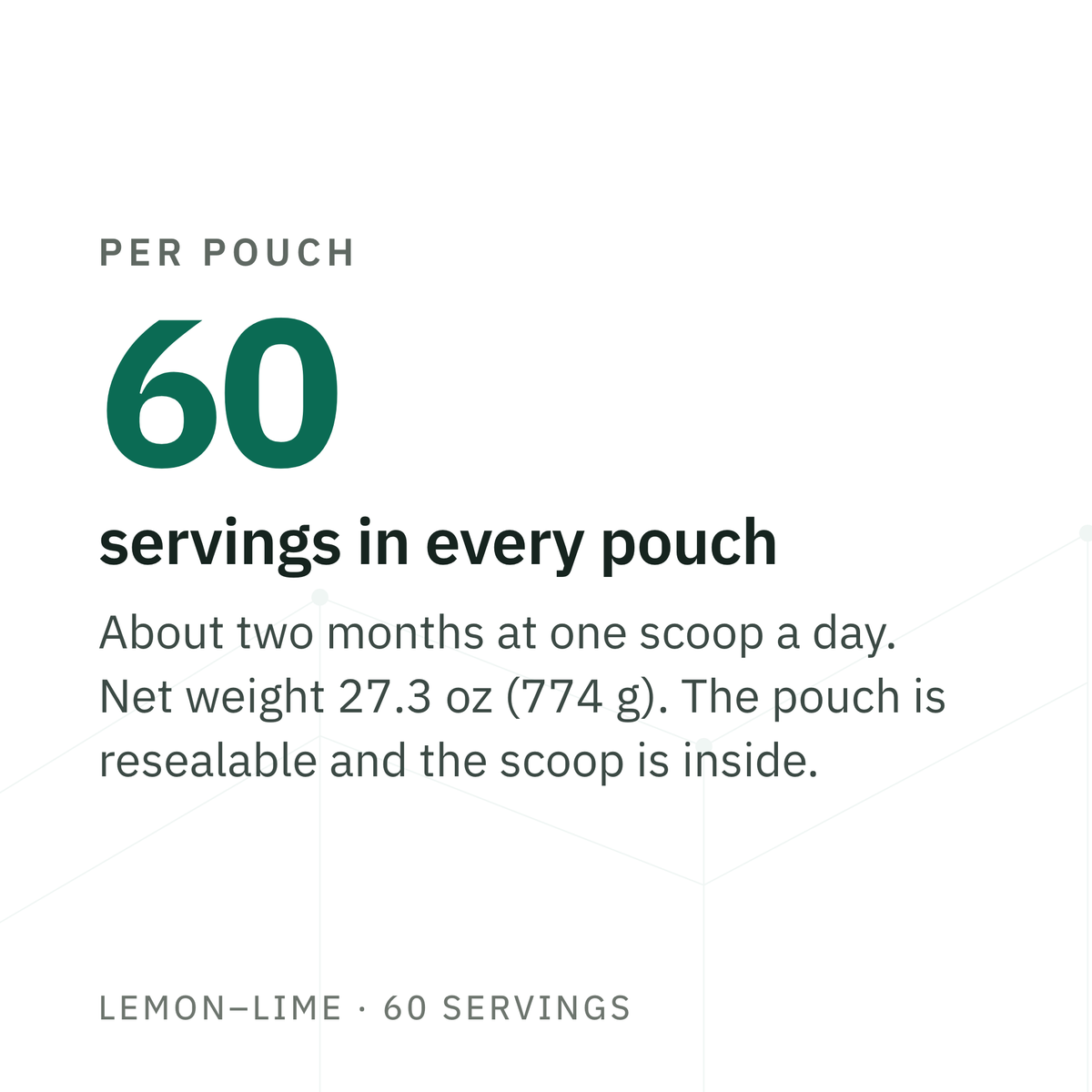
One pouch holds 60 servings, so about two months at one scoop a day. Net weight 27.3 oz (774 g). Resealable zipper, with a scoop inside.

The rest of the pouch is malic acid, natural lemon and lime flavor, allulose and monk fruit extract. It isn't sweetened with table sugar.

Supplement Facts

Serving Size 1 scoop (12.9 g)
Servings Per Container 60

Amount Per Serving% Daily Value
Calories20
Total Carbohydrate 12 g4%*
Dietary Fiber (from acacia gum) 10 g36%*
Potassium (as potassium citrate) 500 mg11%

*Percent Daily Values are based on a 2,000 calorie diet.

Other ingredientsMalic acid, natural lemon-lime flavor, allulose, monk fruit extract.

Provisional. The 10 g of fiber and 500 mg of potassium per scoop are fixed. The panel printed on the pouch you receive is the final word.

Ordering

How the pre-sale works

The first production run is 1,500 pouches, and they're being sold before they're made. You pay at checkout, where shipping is calculated, and pre-sale orders ship from 1 December 2026.

A first run is a guess about demand. Taking orders first tells us whether 1,500 was the right guess before we plan the next batch.

If you change your mind before your order is dispatched, contact us and we'll cancel it and refund you in full.

The pre-sale in three steps, from order to shipping on 1 December 2026 Step one: you order now and are charged at checkout. Step two: the first run of 1,500 pouches is made. Step three: pre-sale orders ship from 1 December 2026. 1 You order now Charged at checkout. 2 The run is made 1,500 pouches in the first run. 3 1 December 2026 Pre-sale orders ship from this date.

Questions about the drink

What does it taste like, and what sweetens it?

Lemon and lime, lightly sweetened and on the tart side. Because acacia gum doesn't thicken, the drink stays thin, close to plain water in texture. Cold water suits it best.

It isn't sweetened with table sugar. The current formula uses allulose and monk fruit extract. The label stays provisional until the manufacturer signs off, and your pouch carries the final list.

How does it mix?

Stir one scoop into at least 300 mL (about 10 fl oz) of cold water and drink it. It dissolves readily, and it works in sparkling water or over ice. Hot drinks are fine too, though the lemon and lime flavor is designed for cold. Don't mix it into a drink you plan to leave sitting for hours.

Can I take it with other medicines?

Take other medicines at least two hours before or after a scoop. Fiber can change how the gut absorbs some medicines: in a study of 24 healthy volunteers, gum arabic, another name for acacia gum, taken at the same time as the antibiotic amoxicillin lowered the peak level of the antibiotic in the blood, compared with taking the gum two hours later.

If you take anything regularly, your pharmacist or doctor can check your list.

Who should check with a doctor before using it?

Ask your own doctor before you start if you have kidney disease or any other condition that affects how your body clears potassium, if you have been told to limit potassium, or if you take a medicine that can raise potassium: an angiotensin converting enzyme inhibitor (an ACE inhibitor, such as benazepril), an angiotensin receptor blocker (such as losartan) or a potassium-sparing diuretic (such as spironolactone). Type 1 diabetes, heart failure, adrenal insufficiency and liver disease also raise the risk of potassium building up in the blood, so the same conversation applies.

If a clinician has restricted your diet, for example a low-FODMAP, low-residue or texture-modified diet, ask that clinician before adding any fiber supplement.

Count every source of potassium, too. A supplement, a salt substitute and an electrolyte drink taken on the same day all add together.

It isn't for children. Pregnant or breastfeeding? Check with your doctor first.

Is it vegan? Is it gluten free?

Acacia gum comes from a tree and potassium citrate is a mineral salt, and neither contains gluten. We'll publish the manufacturer's finished allergen and dietary statements on this page before the first pouches ship.

How does the pre-sale work?

The first production run is 1,500 pouches. You pay at checkout, and pre-sale orders ship from 1 December 2026. The box above the Pre-order button shows how many have been ordered so far.

There's no subscription during the pre-sale; this first run is a one-off purchase.

Safety

Contains 500 mg of added potassium per serving (1,000 mg at the two-scoop daily maximum). Talk to your doctor before using this product if you have kidney disease, if you have been told to limit potassium, or if you take an angiotensin converting enzyme inhibitor (often called an ACE inhibitor), an angiotensin receptor blocker, a potassium-sparing diuretic, or any other potassium supplement. Not for children. Keep out of reach of children. If you are pregnant or breastfeeding, ask your doctor first.